

By Allen Smith
February 27, 2026
On Thursday, February 26, the NCAA released the qualifier pre-allocations for each conference at each weight class. Whether this sounds Greek to you, or you are a seasoned veteran and knowledgeable about the process used to qualify wrestlers for the NCAA Wrestling Championships or somewhere in-between, this article is intended to help everyone. By breaking down the process into steps, and hopefully writing in easy-to-understand terms, my aim is to give newbies and the less-knowledgeable a starter lesson, and maybe even teach long-time fans a thing or two. The step-by-step explanation of the process starts in the next paragraph below. At the end, a few paragraphs explaining specifics about Penn State wrestlers will be provided. Then, at the very bottom of this article you can find the pre-allocation table. Hopefully, when you are finished reading, you will have a better understanding!
THE CRITERIA
The first step in the process is to stack rank all of the wrestlers in each weight class in each of three criteria. Those three criteria are; 1) Win %, 2) Coaches Ranking and 3) RPI. Each is explained below. Before beginning though, it should be noted that the number of wrestlers in the brackets of the NCAA Wrestling Championships is 33 per weight class. Most often below, as we go through the process, you will see the number “29”, as it is the maximum number of pre-allocations.
Win % is easy to understand. Using only bouts wrestled at their specific weight class, and not counting bouts against teammates or non-Division 1 wrestlers, each wrestler’s winning percentage is calculated. A wrestler must have at least eight bouts to have a Win %, or they are excluded from the list. For example, if John Doe has 10 bouts at 133 and all are against Division 1 foes, winning seven of those give a Win % of .700 or 70%. If John Doe only has six bouts, he would not be on the list, regardless of how many bouts he won. Once all wrestlers’ Win %’s have been calculated, all of the wrestlers are stack-ranked by weight class from high to low. There will be 10 lists total, one for each of the 10 weight classes.
Coaches Ranking is just as easy to understand. A select group of coaches and NCAA Wrestling Committee individuals provide a ranking for the weight classes. Once compiled, a Coaches Ranking of the top 33 wrestlers per weight class is released. The final Coaches Ranking was released at the same time as the pre-allocations by the NCAA. You can find this ranking easy enough on the internet. As with Win %, eight bouts at a wrestler’s weight class are needed to have a Coaches Ranking. Think of this metric as a ranking from Flowrestling or Intermat, it would be very similar.
RPI is the third and is the hardest to understand. RPI stands for Rating Performance Index. It is a measure of a wrestler’s strength-of-schedule. I won’t get into the math here, as the amount of data collected is extensive. Keeping it as simple as possible, three levels of Win % are used to calculate a single number that measures the strength of a wrestler’s schedule. They are; 1) a wrestler’s own win percentage, 2) a composite calculation of their opponent’s win percentages, and 3) a composite calculation of the opponents of their opponents win percentages. In principle and practice, the harder a wrestler’s schedule during the season, the higher the number. Wrestling an easy schedule and the number will be lower. The NCAA released the top 33 RPI list for all weight classes, ranked highest to lowest, at the same time the pre-allocation table was released. Unlike Win % and Coaches Ranking, 15 minimum bouts are required in a weight class to even be on the list, so some wrestlers don’t make the list. Got it so far? Let us move on.
EARNING AN ALLOCATION FOR YOUR CONFERENCE – STEP 1
Once all three lists are known (Win %, Coaches Ranking & RPI), the next step is fairly easy to understand. The NCAA Wrestling Committee compiles a list in each weight class of those wrestlers that meet at least two of these three criteria, starting with; 1) a 70% (or .700) Win %, 2) a top-30 Coaches Ranking, and/or 3) a top-30 RPI.
Each weight class is looked at separately, and if the number of wrestlers meeting two of the three criteria is 29 or 28 or sometimes 27, that weight class is done. If a weight class has more than 29 wrestlers meeting at least two of the criteria, the scale of the three criteria is moved, the first move is; 1) a 71% (or .710) Win %, 2) a top-29 Coaches Ranking, and/or 3) a top-29 RPI. You will notice that each measure is a bit different than that in the previous paragraph. Same thing as before, if 29 or 28 or sometimes 27 wrestlers meet at least two criteria, that weight class is done. The criteria continues to slide until 29 wrestlers, or just one or two fewer, meet at least two of the criteria in all 10 weight classes.
I think of “29” wrestlers per weight class as the “magic number”, though the criteria at times yields 28 or 27, as these are acceptable too. In the table at the bottom of this article, you will see 29 total pre-allocations at eight weight classes and 28 total pre-allocations at two weights (125 and 165). The reason is that it allows at least four at-large selections (33 minus 29) later in the process. Good wrestlers that have a poor conference tournament and do not auto-qualify can still make the NCAA Wrestling Championships, but that is getting a bit ahead of the process and will be explained later.
EARNING AN ALLOCATION FOR YOUR CONFERENCE – STEP 2
The next step is to look at all 29 or so wrestlers that met two of the three criteria, and look at the conference in which they wrestle. Using 125 as an example, and peaking at the table at the bottom of this article; five (5) wrestlers were from the Atlantic Coast Conference, five (5) from the Big 12 Conference, nine (9) from the Big Ten Conference, and so on. For the Big Ten, another way to say this is that nine of the 14 Big Ten Conference wrestlers EARNED THE CONFERENCE A SLOT AT THE NCAA WRESTLING CHAMPIONSHIPS. This is NOT the same as saying that those nine wrestlers that earned the slot are the ones going to the big dance. Far from it, as you will see.
WRESTLERS EARNING A SPOT AT THE NCAA CHAMPIONSHIPS – STEP 1
Next are the conference championships, of which there are eight, as listed down the left side of the table below; starting with the Atlantic Coast Conference alphabetically to the Southern Conference. All are competed on the same weekend, Friday, March 6, 2026 through Sunday, March 8, some are one day tournaments and others are two day tournaments. By Sunday evening, March 8, we will know EVERY AUTO-QUALIFIER FROM EVERY CONFERENCE. What is an AUTO-QUALIFIER? Again, refer to the table below. Any wrestler that finishes their conference tournament at or above the pre-allocation number automatically has stamped their ticket to the NCAA Wrestling Championships. Using a Penn State example, if Luke Lilledahl finishes in the top nine at the Big Ten Wrestling Championships, he’s heading to Cleveland as the Big Ten has a pre-allocation at the 125 pound weight class of nine wrestlers. Hopefully you can clearly see that earning your conference an allocation slot at a conference championship is not the same as a wrestler earning their way to the NCAA Wrestling Championships. Heck, if the #14 seed at 125 pounds in the Big Ten Wrestling Championships finishes top nine, they are heading to Cleveland! We say that they “stole” the spot from another wrestler, as a #14 seed surely did not earn a pre-allocation slot for their conference.
Look at the table again, far right side, and you will see the number 87 for the Big Ten Conference. After wrestling is finished Sunday evening, March 8, everyone will know which 87 wrestlers are heading to Cleveland from the Big Ten as AUTO-QUALIFIERS. These 87 wrestlers have AUTOMATICALLY QUALIFIED by virtue of their individual performance at the Big Ten Wrestling Championships. We will also know which 39 are going from the Atlantic Coast Conference, which 63 are going from the Big 12 Conference, and so on. The individual numbers also have meaning that you should be aware of. On the Big Ten Conference line, you will find the number “10” at both 174 and 197. This means 10 of the 14 wrestlers at the Big Ten Wrestling Championships will earn their way to Cleveland and the NCAA Wrestling Championships at those two weight classes. That is a high number, and suggests that these two weight classes top-to-bottom are very, very good in the Big Ten Conference and nationally. Similarly, the “7” noted for weight class 141 suggests that it is the weakest weight class overall in the Big Ten, as conference wrestlers have only earned seven slots at that weight class.
AT-LARGE SELECTIONS
Almost done! The final step on the road to Cleveland is determining the at-large wrestlers at each weight class. Remember, there are at least four, and sometimes five or six. This year there are four at every weight class except 125 and 165 where there are five (see table below if you want to check this out). Immediately after the conference tournaments, on March 9, wrestlers in each weight class will receive an updated Win %, RPI and coaches’ ranking that includes all competition through the qualifying tournaments. In addition, a few other criteria are added, such as “one win against a wrestler receiving an earned, pre-allocated slot”. A wrestler-to-wrestler comparison is made, a stack-ranking is created and the top four wrestlers – or top five at 125 and 165 where there are only 28 pre-allocation slots – get an at-large bid. The process is now complete and we know which 33 wrestlers at each weight class will be heading to Cleveland on the third weekend in March. Start to finish, the process is now criteria and performance-based. Gone are the days long ago where “wildcards” were selected by vote from within each conference. Subjectivity has been replaced by objectivity as much as possible. This finishes the process, each weight class now having 33 wrestlers to load into the NCAA Wrestling Championship brackets. The process of seeding at the NCAA Wrestling Championships is worthy of its very own explanation!
To wrap up the at-large selections, hopefully it is obvious that the best wrestlers in each weight that DID NOT finish inside the auto-qualifier range at their conference championship will earn the at-large bids. Most likely these are highly-ranked wrestlers that had a poor conference championship tournament, maybe they were injured, or possibly some other reason. Regardless, it gives wrestlers a second way to get to the NCAA Wrestling Championships.
PENN STATE’S STORY
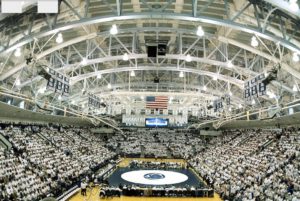
To bring this close to home, and since this article is written for a Penn State crowd, it is worth looking at the Penn State wrestlers, and their specific situations heading into the Big Ten Wrestling Championships. As I am writing this, Penn State has six of their ten wrestlers as number one seeds and two wrestlers as number two seeds at the Big Ten Wrestling Championships, held on the campus of Penn State at the Bryce Jordan Center. As both of the top two seeds get a bye in the first round, their paths to auto-qualify are identical. Those wrestlers are; Luke Lilledahl (125), Marcus Blaze (133), Shayne Van Ness (149), PJ Duke (157), Mitchell Mesenbrink (165), Levi Haines (174), Rocco Welsh (184) and Josh Barr (197). All eight need to win one (1) bout anywhere in either bracket (championship bracket OR wrestleback bracket). The bye gets them to the second round, winning there earns them no worse than 6th Place. Losing their second round bout, and winning one bout in wrestlebacks, and they are guaranteed to finish no worse than 8th Place. Looking at the number of pre-allocations for these weight classes, eight (8) is the lowest number, so onto Cleveland they go. Of course the expectation is that these wrestlers win more than one bout each, but the focus of this article is getting to Cleveland.
Next is Cole Mirasola (285), who is seeded number four. Mirasola does NOT have a first round bout, and needs two bout wins anywhere in either bracket to auto-qualify for Cleveland and the NCAA Wrestling Championships. Winning his first two mbouts in the championship earns a top six finish, while winning his first bout, losing his second round bout, then winning his first wrestleback bout guarantees an 8th Place finish. With a pre-allocation of nine (9) for the 285 pound weight class, a guaranteed 8th Place finish does it, and Mirasola will be heading to Cleveland!
Lastly, Braeden Davis (141) has a different situation, as the Big Ten has earned seven pre-allocations at his weight class, meaning Davis must finish in the top seven to auto-qualify for the NCAA tournament. There are several paths for Davis, actually three, as follows; 1) win his first two bouts in the championship bracket, guaranteeing no worse than a 6th Place finish, or 2) win his first round bout, then if he loses his second round bout, will have to win two bouts anywhere in wrestlebacks, guaranteeing no worse than a 7th Place finish, or 3) if Davis loses his first round bout, he’ll get a bye in wrestlebacks, then must win any two bouts in wrestlebacks. This explanation may sound confusing, especially if you are unfamiliar with the brackets and how they can play out. Regardless, Davis should earn his spot in Cleveland.
There you have it. Soup to nuts, everything you wanted to know about qualifying for the national tournament. Hopefully this article was clear enough and there were enough nuggets of new information that the reading was worthwhile. Next step is sitting back and enjoying the post-season. WE ARE!!
| Conference | 125 | 133 | 141 | 149 | 157 | 165 | 174 | 184 | 197 | 285 | Total |
| Atlantic Coast Conference | 5 | 3 | 5 | 4 | 4 | 4 | 3 | 4 | 3 | 4 | 39 |
| Big 12 Conference | 5 | 8 | 7 | 5 | 5 | 4 | 7 | 8 | 8 | 6 | 63 |
| Big Ten Conference | 9 | 8 | 7 | 9 | 8 | 9 | 10 | 8 | 10 | 9 | 87 |
| Eastern Intercollegiate Wrestling Association | 2 | 2 | 3 | 1 | 2 | 4 | 3 | 3 | 2 | 4 | 26 |
| Ivy League | 2 | 2 | 3 | 3 | 4 | 3 | 2 | 1 | 1 | 2 | 23 |
| Mid-American Conference | 2 | 4 | 2 | 4 | 4 | 2 | 2 | 3 | 2 | 2 | 27 |
| Pacific-12 Conference | 2 | 1 | 1 | 2 | 1 | 1 | 1 | 1 | 2 | 1 | 13 |
| Southern Conference | 1 | 1 | 1 | 1 | 1 | 1 | 1 | 1 | 1 | 1 | 10 |
| Pre-Allocations | 28 | 29 | 29 | 29 | 29 | 28 | 29 | 29 | 29 | 29 | 288 |
| At-Large | 5 | 4 | 4 | 4 | 4 | 5 | 4 | 4 | 4 | 4 | 42 |
5 thoughts on “NCAA Qualifier Allotments are out!”
Comments are closed.